Performance management that engineering teams actually want to use
MeritStack turns project completions into meaningful growth conversations through AI-powered feedback collection and native developer tool integration.
Why MeritStack
Performance reviews for engineering teams are broken: everyone dreads them, nobody thinks they work, yet the alternative is worse.
But the problem with performance reviews isn't the process. It's the feedback!
Most feedback is generic and low-signal because writing good feedback is hard: it's a low-frequency, high-stakes task that no one practices. MeritStack changes that.
Time & Disruption
Before
Multiple weeks of organizational bandwidth consumed
Delivery cycles halted during review periods
Process dreaded across teams
Before
Multiple weeks of organizational bandwidth consumed
Delivery cycles halted during review periods
Process dreaded across teams
Before
Multiple weeks of organizational bandwidth consumed
Delivery cycles halted during review periods
Process dreaded across teams
After
Feedback captured naturally between projects
10-15 minute windows during cognitive transitions
Performance management integrated into workflow, not disrupting it
After
Feedback captured naturally between projects
10-15 minute windows during cognitive transitions
Performance management integrated into workflow, not disrupting it
After
Feedback captured naturally between projects
10-15 minute windows during cognitive transitions
Performance management integrated into workflow, not disrupting it
Feedback Quality
Before
Generic platitudes instead of actionable feedback
Memory fades over months
Fear of offending colleagues creates safe, vague statements
Managers overwhelmed with low-signal input
Before
Generic platitudes instead of actionable feedback
Memory fades over months
Fear of offending colleagues creates safe, vague statements
Managers overwhelmed with low-signal input
Before
Generic platitudes instead of actionable feedback
Memory fades over months
Fear of offending colleagues creates safe, vague statements
Managers overwhelmed with low-signal input
After
Fresh context captured at project completion
Specific, concrete impact documented
AI-guided structure eliminates blank-page paralysis
Managers receive high-signal input ready for growth conversations
After
Fresh context captured at project completion
Specific, concrete impact documented
AI-guided structure eliminates blank-page paralysis
Managers receive high-signal input ready for growth conversations
After
Fresh context captured at project completion
Specific, concrete impact documented
AI-guided structure eliminates blank-page paralysis
Managers receive high-signal input ready for growth conversations
Developer Experience
Before
Engineers dread blank page and memory fog
Generic feedback feels disconnected from real work
Managers drain during weeks of synthesis
Imposter syndrome from inadequate material
Feedback arrives 4+ months late, wasted opportunity for growth
Before
Engineers dread blank page and memory fog
Generic feedback feels disconnected from real work
Managers drain during weeks of synthesis
Imposter syndrome from inadequate material
Feedback arrives 4+ months late, wasted opportunity for growth
Before
Engineers dread blank page and memory fog
Generic feedback feels disconnected from real work
Managers drain during weeks of synthesis
Imposter syndrome from inadequate material
Feedback arrives 4+ months late, wasted opportunity for growth
After
Reflecting on fresh work feels natural, not performative
Impact articulated while still relevant
Managers receive usable material immediately
Timely feedback that actually matters
After
Reflecting on fresh work feels natural, not performative
Impact articulated while still relevant
Managers receive usable material immediately
Timely feedback that actually matters
After
Reflecting on fresh work feels natural, not performative
Impact articulated while still relevant
Managers receive usable material immediately
Timely feedback that actually matters
MeritStack transforms feedback from low-frequency, high-stakes to high-frequency, low-stakes, captured continuously when work naturally completes.
How it works
From project completion to meaningful feedback
Project Complete
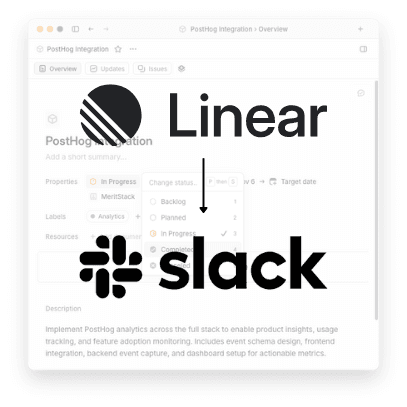
When your team merges the last PR and completes a Linear project, MeritStack automatically detects it. No additional forms, no interruptions—just the natural end of a project.
Project Complete
When your team merges the last PR and completes a Linear project, MeritStack automatically detects it. No additional forms, no interruptions—just the natural end of a project.
Project Complete
When your team merges the last PR and completes a Linear project, MeritStack automatically detects it. No additional forms, no interruptions—just the natural end of a project.
Feedback Requested
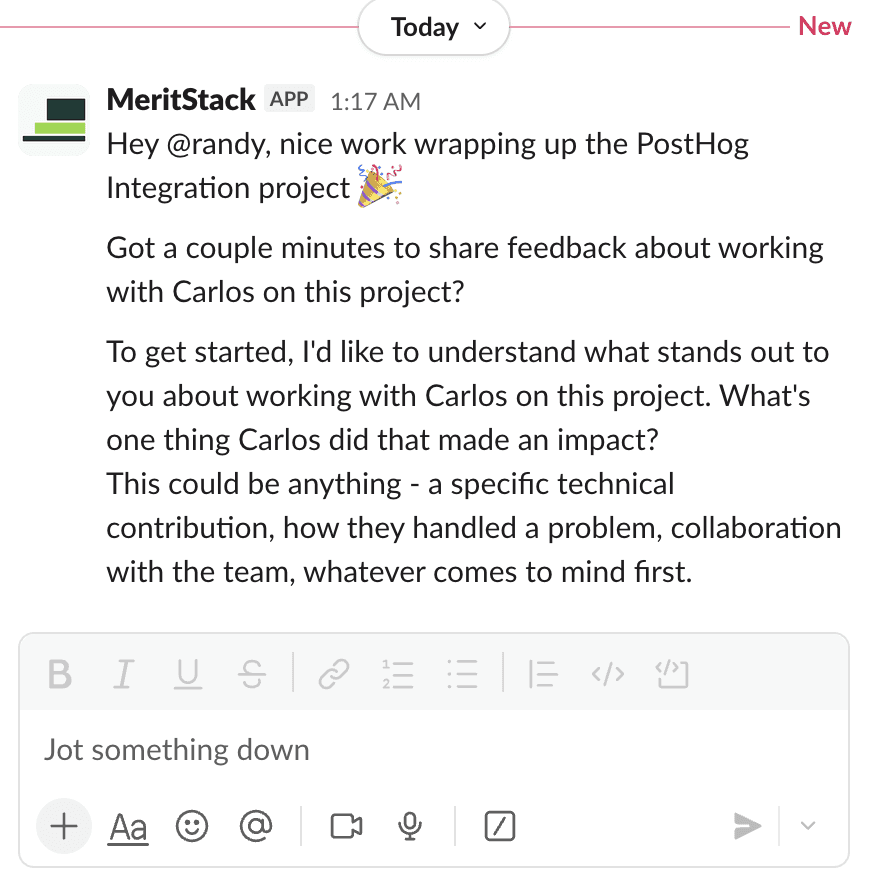
Team member get pinged via Slack. It's low-stakes, conversational, and triggered by actual work—not an arbitrary calendar date.
Feedback Requested
Team member get pinged via Slack. It's low-stakes, conversational, and triggered by actual work—not an arbitrary calendar date.
Feedback Requested
Team member get pinged via Slack. It's low-stakes, conversational, and triggered by actual work—not an arbitrary calendar date.
First Response
The first response is usually generic—exactly the kind of low-signal feedback that dominates traditional reviews. This is normal. It's hard to write good feedback off the top of your head.
That's great to hear! I can tell Carlos made a real impact. Now let's dig into the specifics so we can capture what actually happened.
What exactly did Carlos do to implement PostHog? Can you walk me through some concrete actions or decisions he made? […]
First Response
The first response is usually generic—exactly the kind of low-signal feedback that dominates traditional reviews. This is normal. It's hard to write good feedback off the top of your head.
Carlos did a fantastic job implementing PostHog. I really enjoyed working with him! He made this project a success.
First Response
The first response is usually generic—exactly the kind of low-signal feedback that dominates traditional reviews. This is normal. It's hard to write good feedback off the top of your head.
That's great to hear! I can tell Carlos made a real impact. Now let's dig into the specifics so we can capture what actually happened.
What exactly did Carlos do to implement PostHog? Can you walk me through some concrete actions or decisions he made? […]
AI Coaching
The AI guides the conversation with targeted questions that surface specifics: What actually happened? What was the context? What was the outcome? The back-and-forth takes 5-10 minutes.
The AI guides the conversation with targeted questions that surface specifics: What actually happened? What was the context? What was the outcome? The back-and-forth takes 5-10 minutes.
AI Coaching
The AI guides the conversation with targeted questions that surface specifics: What actually happened? What was the context? What was the outcome? The back-and-forth takes 5-10 minutes.
That's great to hear! I can tell Carlos made a real impact. Now let's dig into the specifics so we can capture what actually happened.
What exactly did Carlos do to implement PostHog? Can you walk me through some concrete actions or decisions he made? […]
AI Coaching
The AI guides the conversation with targeted questions that surface specifics: What actually happened? What was the context? What was the outcome? The back-and-forth takes 5-10 minutes.
The AI guides the conversation with targeted questions that surface specifics: What actually happened? What was the context? What was the outcome? The back-and-forth takes 5-10 minutes.
Result
The feedback is now objectively describing the behavior of the team member and the observable impact on the project, the team, and the company. Situation, Behavior, Impact.
During the PostHog Integration project, Carlos created a tech spec which defined a comprehensive event schema and catalog. He then integrated the Python SDK into our codebase—adding the dependency, testing for compatibility, and building a lightweight wrapper to auto-capture important contextual data by default. This upfront structure eliminated the inconsistent naming patterns and redundant events we'd struggled with in past instrumentation work. The schema and wrapper made it significantly easier for the team to instrument code consistently and move faster, while reducing the likelihood of collecting erroneous data. […]
Result
The feedback is now objectively describing the behavior of the team member and the observable impact on the project, the team, and the company. Situation, Behavior, Impact.
During the PostHog Integration project, Carlos created a tech spec which defined a comprehensive event schema and catalog. He then integrated the Python SDK into our codebase—adding the dependency, testing for compatibility, and building a lightweight wrapper to auto-capture important contextual data by default. This upfront structure eliminated the inconsistent naming patterns and redundant events we'd struggled with in past instrumentation work. The schema and wrapper made it significantly easier for the team to instrument code consistently and move faster, while reducing the likelihood of collecting erroneous data. […]
Result
The feedback is now objectively describing the behavior of the team member and the observable impact on the project, the team, and the company. Situation, Behavior, Impact.
During the PostHog Integration project, Carlos created a tech spec which defined a comprehensive event schema and catalog. He then integrated the Python SDK into our codebase—adding the dependency, testing for compatibility, and building a lightweight wrapper to auto-capture important contextual data by default. This upfront structure eliminated the inconsistent naming patterns and redundant events we'd struggled with in past instrumentation work. The schema and wrapper made it significantly easier for the team to instrument code consistently and move faster, while reducing the likelihood of collecting erroneous data. […]